
8
Category: Chemistry
20
7
11

Important Ground Rules for Completing these Quizzes
Please read!
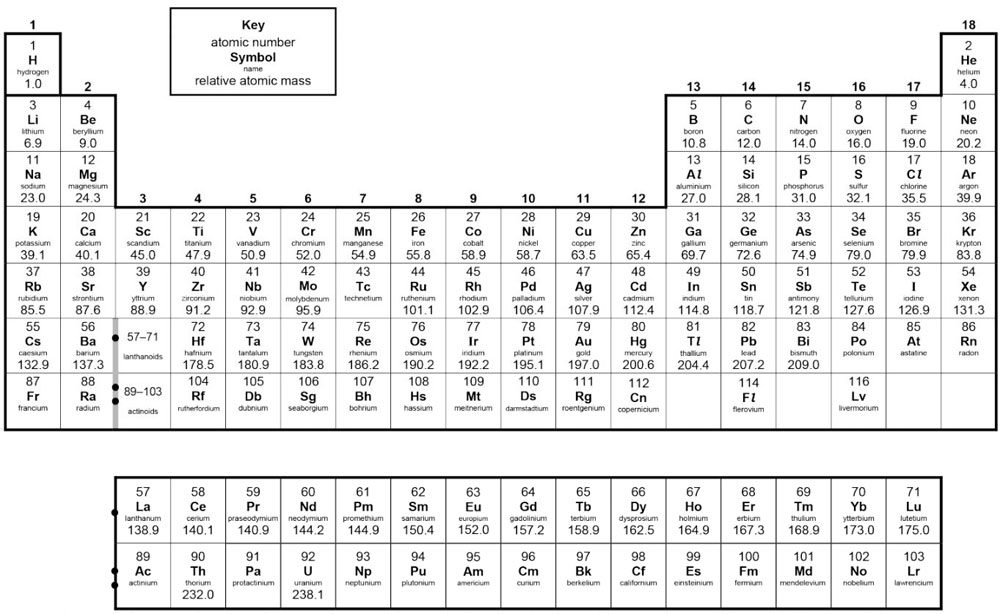
Only use the data from the A Level Periodic Table which shows the appropriate number of decimal places and correct spellings. All exam boards have a common Periodic Table at A level.
Entering numerical answers
- All your answers should be to 3 significant figures where relevant.
- Use the relative atomic mass values from the A Level Periodic Table to calculate relative molecular/formula masses.
Carry out your calculations on paper. Check them carefully for spelling and significant figures before entering your answers into the quiz.
Some examples are offered below. Please look at them.
Example 1
Question: Calculate the mass present in 0.250 mol of zinc.
Answer: 0.250 x 63.5=15.875
You should only enter 15.9 Any other answer will be marked as incorrect so be careful!
Example 2
Question: Calculate the mass in 1.50 mol of chromium
Answer: 1.50 x 52.0=78
You should only enter 78.0 Any other answer will be marked as incorrect so be careful!
Example 3
Question: Calculate the number of moles of chromium present in 0.780 g of chromium
Answer: 0.78/52.0=0.015
You should only enter 0.0150 Any other answer will be marked as incorrect so be careful!
Example 4
Question: Calculate the relative formula mass of calcium carbonate CaCO3
Answer: 40.1 + 12.0 + (3 x 16.0) = 100.1
You should only enter 100.1 Note that this is to 4 significant figures. This is the level of accuracy provided by the A Level Periodic Table.
Entering Chemical Names
There are some simple rules.
- All letters are lowercase.
- The roman numerals are uppercase versions of the letters v& i
- There is one space each side of the bracketed roman numerals and the text.
- Correct spellings of elements are only those on your periodic table. e.g. sulfur not sulphur.
Example 1
Question: Name a compound with the formula Fe2(SO4)3
Answer: iron (III) sulfate
Example 2
Question: Name a compound with the formula MnO2
Answer: manganese (IV) oxide
Entering Chemical Formulae
There are some simple rules.
You are unable to enter subscripts or superscripts into the quiz answer box.
To enter a chemical formula, ignore subscripts and superscripts.
Example 1
Question: Write down the formula hydrogen peroxide.
Answer: H2O2
Example 2
Question: Write down the formula aluminium nitrate
Answer: Correct formula is Al(NO3)3
You enter Al(NO3)3
Foundations in Chemistry – Module 2
This module is designed to build upon the fundamental concepts learned in GCSE Chemistry.
Models that were sufficient to explain and predict the chemistry at GCSE level are modified and extended to be able to explain the properties and reactions of a wider range of chemical species that are encountered at Advanced Level.
Examples of this include:
- refining the model of electronic structure of atoms and ions to explain the formation of compounds where atoms expand their octet.
- development of the ideal gas equation for the calculation of the amount of gases under non-standard conditions.
- introduction of the oxidation numbers model to allow students to identify REDOX reactions for more challenging examples that don’t involve simple ions.
- explanation and application of electronegativity to allow students to appreciate the non-binary nature of bonding, i.e. ionic ‘v’ covalent. Also, electronegativity is used to explain the polarity of bonds and the resulting strength of intermolecular forces.
- M2S1 – Atomic Structure
- M2S2 – Electronic Configurations
- M2S3 – Moles
- M2S4 – Hydrates
- M2S5 – Ionic Structure and Bonding
- M2S6 – Covalent Structures and Bonding
- M2S7 – Shapes of Molecules
- M2S8 – Intermolecular Forces
- M2S9 – Metallic Structures and Bonding
- M2S10 – States of Matter and Structures
- M2S11 – Acid Base Reactions 1
- M2S12 – Redox Reactions
Period Table & Energy – Module 3
This module focuses mainly on the inorganic and physical branches of chemistry. Many topics within this module will be familiar to students from GCSE but those foundations will be built open.
Skills developed in Module 2: Foundations in Chemistry, will be necessary to underpin the learning in the module.
Examples of concept developed in the module include:
- the concept of periodicity will be studied from several perspectives including the variation in the sizes of atoms, first ionization energies as evidence for electronic structure, and the nature of bonding within elements across a period.
- study of the chemistry of Group 2 and a comparison with Group 1, studied at GCSE.
- further study of the chemistry of Group 7 to demonstrate the ability of the halogens to form higher oxidation states in compounds.
- more sophisticated explanations of the effect of conditions on reaction rates by the use of Maxwell-Bolzman distribution profiles.
- a more quantitative approach to the description of equilibrium position through the calculation of equilibrium constant, Kc.
- the simple understanding of energy changes in chemical reactions, introduced in GCSE, will be strengthened by defining several specific enthalpy changes and by the application of Hess’s Law.
- M3S1 – Periodicity
- M3S2 – Oxidation Numbers
- M3S3 – Group 2
- M3S4 – Group 7
- M3S5 – Enthalpy Changes Year 1
- M3S6 – Enthalpy Calculations for Year 1
- M3S7 – Equilibrium
Core Organic Chemistry – Module 4
- This module extends some of the physical chemistry topics that were introduced in Module 3. These include:
- a quantitative approach will be taken towards the explanation of the factors affecting rate including concentration and temperature.
- rate equations will be developed for chemical processes to predict the effect of a change in concentration of a reactant upon the rate of reaction and to allow reaction mechanisms to be suggested.
- equilibrium position will be further quantified and extended to cover the equilibrium constant, Kp.
- equilibrium position in acid-base equilibria will be quantified using equilibrium constant Ka. This will be applied to estimate the pH of strong and weak acids, and partially neutralised weak acids (buffers)
- lattice enthalpies will be explained and calculated using Born-Haber Cycles.
- thermodynamics will be studied at a basic level so that reaction feasibility can be predicted at varied temperatures. The topic will include the concept of entropy and Gibbs (free) Energy.
- electrochemistry will be covered so that the function of disposable, rechargeable and fuel cells can be understood.
- M4S1 – Alkanes
- M4S2 – Alkenes
- M4S3 – Alcohols
- M4S4 – Haloalkanes
- M4S5 – Instrumental Analysis IR & MS
- M4S6 – Year 1 Isomerism
- M4S7 – Year 1 Organic Nomenclature
Physical Chemistry & Transition Elements – Module 5
- This module extends some of the physical chemistry topics that were introduced in Module 3. These include:
- a quantitative approach will be taken towards the explanation of the factors affecting rate including concentration and temperature.
- rate equations will be developed for chemical processes to predict the effect of a change in concentration of a reactant upon the rate of reaction and to allow reaction mechanisms to be suggested.
- equilibrium position will be further quantified and extended to cover the equilibrium constant, Kp.
- equilibrium position in acid-base equilibria will be quantified using equilibrium constant Ka. This will be applied to estimate the pH of strong and weak acids, and partially neutralised weak acids (buffers)
- lattice enthalpies will be explained and calculated using Born-Haber Cycles.
- thermodynamics will be studied at a basic level so that reaction feasibility can be predicted at varied temperatures. The topic will include the concept of entropy and Gibbs (free) Energy.
- electrochemistry will be covered so that the function of disposable, rechargeable and fuel cells can be understood.
Physical Chemistry & Transition Elements
- M5S1 – Kinetics 1
- M5S2 – Kinetics 2
- M5S3 – Kinetics and Orders of Reaction
- M5S4 – Mechanisms and Orders
- M5S5 – Calculating Mole Fractions
- M5S6 – Equilibria Kc & Kp
- M5S7 – Calculating Kc and Kp
- M5S8 – Acid Base Equilibria 2
- M5S9 – Born Haber Cycles
- M5S10 – Enthalpy Changes for Born-Haber
- M5S11 – Entropy and Gibbs Energy
- M5S12 – Transition Elements
- M5S13 – Complex Ions
- M5S14- Half Equations for REDOX
- M5S15 – REDOX equations from half-equations
- M5S16 – Electrode Potentials 1
- M5S17 – Electrode Potentials 2
- M5S18 – Electrode Potentials 3
Organic Chemistry & Analysis – Module 6
In this module, more organic families with new functional groups will be introduced. General principles of organic chemistry, learned in Module 4, will be applied to help name, explain and predict the chemistry of these new organic families. The new families include:
- aromatic molecules (arenes)
- carboxylic acids their derivatives (esters, anhydrides, acyl chlorides)
- nitrogen containing groups; amines, amides and amino acids
The concept of polymerisation, first introduced at GCSE, will be expanded to cover addition and condensation polymerisation (polyesters and polyamides).
Organic synthesis will be extended to cover reaction sequences covering several steps.
The analytical technique of Nuclear Magnetic Resonance (NMR) spectroscopy will be introduced as a sensitive technique for identifying the arrangement of atoms in organic chemical structures. Interpretation of NMR, IR and Mass Spectra, will be used in combination to confirm the identity of organic molecules.


In this latest version of CramNow we have decided to remove the need to sign up for an account. You can still sign up for an account if you wish. The benefits are:
- Your email will autofill at the end of the quiz
- You will have a record of your past quiz results
- Your quiz score will be added to our league table
- Be the first to know when we add a new quiz
Year 12 1st Half-Term Revision Exercise
Year 12 1st Half-Term Revision Exercise – Marks Scheme
Year 12 Extended Revision – Problem 1
Year 12 Extended Revision – Problem 1 – Answers
Year 12 Extended Revision – Problem 2
Year 12 Extended Revision – Problem 2 – Answers
Inorganic & General Chemistry
Writing Half Equations
Writing Half Equations – Answers
Qualitative Inorganic Analysis 9 Unknown Solids
Qualitative Inorganic Analysis 9 Unknown Solids – Answers
The Chemistry of Hydrates
Handling Dilution Problems
Titration Theory
Working Out Oxidation Numbers
Strategy for Approaching Moles Questions
Organic Chemistry
Curly Arrows in Organic Chemistry
Curly Arrows in Organic Chemistry – Answers
Organic Nomenclature Primer
Combined Analytical Techniques
Combined Analytical Techniques – Answers
Benzene – A Structured Study
Lesson 1
Lesson 2
Lesson 3
Lesson 4
Benzene – A Structured Study – Answers
Lesson 1 – Answers
Lesson 2 – Answers
Lesson 3 – Answers
Lesson 4 – Answers
Spectroscopic Data
Advice for Structural Analysis
Physical Chemistry
Thermodynamics
Thermodynamics Entropy & Gibbs Energy
Reaction Kinetics
Reaction Kinetics
Mechanisms from Orders
The Arrhenious Equation
Electrode Potentials
Standard Electrode Potentials
Enthalpy Changes
Recognising Enthalpy Changes in BH Cycles
Recognising Enthalpy Changes in BH Cycles – Answers
Lattice Enthalpy and Born-Haber Cycles
Enthalpy of Solutions
Extended Enthalpy Problem
Extended Enthalpy Problem – Answers
Support with Laying Out Enthalpy Calculations
Enthalpy of Combustion and Hess’s Law
Constructing a Hess Cycle from Equations
Enthalpy Changes Involved in BH Cycles
Acid-Base Equilibria
Acid-Base Equilibria: Useful Equations
Acid-Base Equilibria
Acid-Base Equilibria: Calculating pH for All Acids Accurately
Acid-Base Equilibria: Blood Buffering
Acid-Base Equilibria: Calculating pH of Bases and Salts
Acid-Base Equilibria: Conjugate Pairs
Acid-Base Equilibria: Indicators
Acid-Base Equilibria: pH of Strong Acids and Bases
Acid-Base Equilibria: pH of Weak Acids
Acid-Base Equilibria: Strong Acid v Strong Base
Acid-Base Equilibria: The Effect of Temperature on pH
Acid-Base Equilibria: Weak Acid v Strong Base
Inorganic & General Chemistry
OCR Flash Cards
These Revision Flash-Cards are specific to the OCR A Chemistry Specification.
Each Module (2-6) is presented in a different colour to make them easier to sort.

OCR Topic Titles have been filled in for you so that they match the OCR specification order.

It’s up to you what questions/answers you write on the cards!
The cards should be folded carefully down the bold black line in the middle of each sheet.
The sheets should be glued on the blank back with a glue stick so that the questions are all on one side and the answers on the other. You may want to lay them under a heavy stack of books to make sure that they are flattened while the glue dries.
Each sheet of 4 questions and answers can then be cut into 4 separate cards.
Test yourself or get other people to test you on them. Practice, practice, practice!
Organic Chemistry
Organic Isomerism Blank Infographic
Organic Isomerism Infographic
Organic Terms
Physical Chemistry
Acid-Base Equilibria: Useful Equations
Enthalpy Change Definitions – Blank
Entropy Equations Infographic
Effect of Temperature on Reaction Feasibility
pH Calculator Tool for Question Writing
Click Here to access the pH Calculator. From the menu, select File > Make Copy. You can then edit your of this document.
Arrhenious Plot Calculator
Click Here to access the pH Calculator. From the menu, select File > Make Copy. You can then edit your of this document.
pH Calculator
Click Here to access the pH Calculator. From the menu, select File > Make Copy. You can then edit this version of the document.