Tools

Data Sheets

Chemistry Tools

Lesson Primers

Y12 Extended Revision

The Rules

Important Ground Rules for Completing these Quizzes

Please read!

Only use the data from the A Level Periodic Table which shows the appropriate number of decimal places and correct spellings. All exam boards have a common Periodic Table at A level.
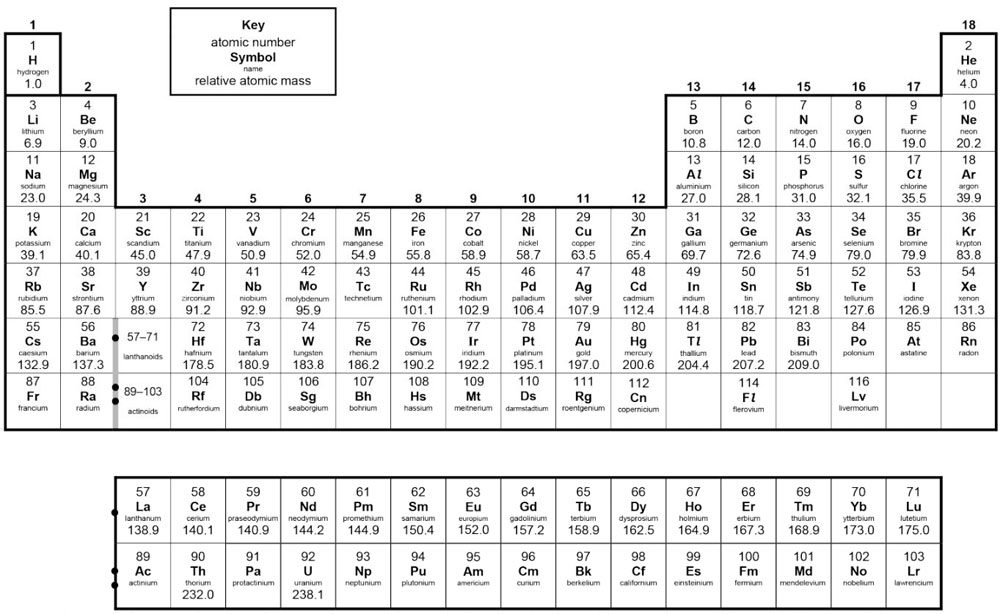
Entering numerical answers

  • All your answers should be to 3 significant figures where relevant.
  • Use the relative atomic mass values from the A Level Periodic Table to calculate relative molecular/formula masses.

Carry out your calculations on paper. Check them carefully for spelling and significant figures before entering your answers into the quiz.

Some examples are offered below. Please look at them.

Example 1

Question: Calculate the mass present in 0.250 mol of zinc.

Answer0.250 x 63.5=15.875

You should only enter 15.9 Any other answer will be marked as incorrect so be careful!

Example 2

Question: Calculate the mass in 1.50 mol of chromium

Answer1.50 x 52.0=78

You should only enter 78.0 Any other answer will be marked as incorrect so be careful!

Example 3

Question: Calculate the number of moles of chromium present in 0.780 g of chromium

Answer0.78/52.0=0.015

You should only enter 0.0150        Any other answer will be marked as incorrect so be careful!

Example 4

Question: Calculate the relative formula mass of calcium carbonate CaCO­3

Answer40.1 + 12.0 + (3 x 16.0) = 100.1

You should only enter 100.1        Note that this is to 4 significant figures. This is the level of accuracy provided by the A Level Periodic Table.

Entering Chemical Names

There are some simple rules.

  • All letters are lowercase.
  • The roman numerals are uppercase versions of the letters v & i
  • There is one space each side of the bracketed roman numerals and the text.
  • Correct spellings of elements are only those on your periodic table. e.g. sulfur not sulphur.

Example 1

Question:    Name a compound with the formula Fe2(SO43

Answer:       iron (III) sulfate

Example 2

Question:    Name a compound with the formula MnO2

Answer:       manganese (IV) oxide

Entering Chemical Formulae

There are some simple rules.

You are unable to enter subscripts or superscripts into the quiz answer box.

To enter a chemical formula, ignore subscripts and superscripts.

Example 1

Question:    Write down the formula hydrogen peroxide.

Answer:       H2O2

Example 2

Question:    Write down the formula aluminium nitrate

Answer:       Correct formula is Al(NO­3)3

You enter    Al(NO3)3

Chemistry Year 13

Physical Chemistry & Transition Elements – Module 5

  • This module extends some of the physical chemistry topics that were introduced in Module 3. These include:
    • a quantitative approach will be taken towards the explanation of the factors affecting rate including concentration and temperature.
    • rate equations will be developed for chemical processes to predict the effect of a change in concentration of a reactant upon the rate of reaction and to allow reaction mechanisms to be suggested.
    • equilibrium position will be further quantified and extended to cover the equilibrium constant, Kp.
    • equilibrium position in acid-base equilibria will be quantified using equilibrium constant Ka. This will be applied to estimate the pH of strong and weak acids, and partially neutralised weak acids (buffers)
    • lattice enthalpies will be explained and calculated using Born-Haber Cycles.
    • thermodynamics will be studied at a basic level so that reaction feasibility can be predicted at varied temperatures. The topic will include the concept of entropy and Gibbs (free) Energy.
    • electrochemistry will be covered so that the function of disposable, rechargeable and fuel cells can be understood.
    This module also introduces some new concepts associated with the chemistry of transition elements. In order to explain some of the aspects of transition metal chemistry, the application of REDOX understanding will be further developed.

Physical Chemistry & Transition Elements

Organic Chemistry & Analysis – Module 6

In this module, more organic families with new functional groups will be introduced. General principles of organic chemistry, learned in Module 4, will be applied to help name, explain and predict the chemistry of these new organic families. The new families include:

  • aromatic molecules (arenes)
  • carboxylic acids their derivatives (esters, anhydrides, acyl chlorides)
  • nitrogen containing groups; amines, amides and amino acids

The concept of polymerisation, first introduced at GCSE, will be expanded to cover addition and condensation polymerisation (polyesters and polyamides).

Organic synthesis will be extended to cover reaction sequences covering several steps.

The analytical technique of Nuclear Magnetic Resonance (NMR) spectroscopy will be introduced as a sensitive technique for identifying the arrangement of atoms in organic chemical structures. Interpretation of NMR, IR and Mass Spectra, will be used in combination to confirm the identity of organic molecules.

Organic Chemistry & Analysis

Chemistry Year 12

Foundations in Chemistry – Module 2

This module is designed to build upon the fundamental concepts learned in GCSE Chemistry.

Models that were sufficient to explain and predict the chemistry at GCSE level are modified and extended to be able to explain the properties and reactions of a wider range of chemical species that are encountered at Advanced Level.

Examples of this include:

  • refining the model of electronic structure of atoms and ions to explain the formation of compounds where atoms expand their octet.
  • development of the ideal gas equation for the calculation of the amount of gases under non-standard conditions.
  • introduction of the oxidation numbers model to allow students to identify REDOX reactions for more challenging examples that don’t involve simple ions.
  • explanation and application of electronegativity to allow students to appreciate the non-binary nature of bonding, i.e. ionic ‘v’ covalent. Also, electronegativity is used to explain the polarity of bonds and the resulting strength of intermolecular forces.

Foundations in Chemisty

Period Table & Energy – Module 3

This module focuses mainly on the inorganic and physical branches of chemistry. Many topics within this module will be familiar to students from GCSE but those foundations will be built open.

Skills developed in Module 2: Foundations in Chemistry, will be necessary to underpin the learning in the module.

Examples of concept developed in the module include:

  • the concept of periodicity will be studied from several perspectives including the variation in the sizes of atoms, first ionization energies as evidence for electronic structure, and the nature of bonding within elements across a period.
  • study of the chemistry of Group 2 and a comparison with Group 1, studied at GCSE.
  • further study of the chemistry of Group 7 to demonstrate the ability of the halogens to form higher oxidation states in compounds.
  • more sophisticated explanations of the effect of conditions on reaction rates by the use of Maxwell-Bolzman distribution profiles.
  • a more quantitative approach to the description of equilibrium position through the calculation of equilibrium constant, Kc.
  • the simple understanding of energy changes in chemical reactions, introduced in GCSE, will be strengthened by defining several specific enthalpy changes and by the application of Hess’s Law.

Period Table & Energy

Core Organic Chemistry – Module 4

  • This module extends some of the physical chemistry topics that were introduced in Module 3. These include:
    • a quantitative approach will be taken towards the explanation of the factors affecting rate including concentration and temperature.
    • rate equations will be developed for chemical processes to predict the effect of a change in concentration of a reactant upon the rate of reaction and to allow reaction mechanisms to be suggested.
    • equilibrium position will be further quantified and extended to cover the equilibrium constant, Kp.
    • equilibrium position in acid-base equilibria will be quantified using equilibrium constant Ka. This will be applied to estimate the pH of strong and weak acids, and partially neutralised weak acids (buffers)
    • lattice enthalpies will be explained and calculated using Born-Haber Cycles.
    • thermodynamics will be studied at a basic level so that reaction feasibility can be predicted at varied temperatures. The topic will include the concept of entropy and Gibbs (free) Energy.
    • electrochemistry will be covered so that the function of disposable, rechargeable and fuel cells can be understood.
    This module also introduces some new concepts associated with the chemistry of transition elements. In order to explain some of the aspects of transition metal chemistry, the application of REDOX understanding will be further developed.

Core Organic Chemistry

M2S12 – Redox Reactions


67

Redox Reactions

1 / 10

The oxidation number of sulfur in sulfuric acid, H2SO4, is:

2 / 10

The oxidation number of vanadium in the VO2+ ion is:

3 / 10

The amount in moles of iodide ions oxidised by one mole of chlorine molecules is:

4 / 10

In the half equation: MnO4- (aq) + 8H+(aq) + ne- -> Mn2+(aq) + 4H2O(l) the value of n is:

5 / 10

Which of these changes are redox reactions?

(i) NaCl(s) + H2SO4(l) -> HCl(g) + NaHSO4(s)

(ii) NH3(g) + HCl(g) -> NH4Cl(s)

(iii) CaCO3(s) -> CaO(s) + CO2(g)

(iv) 2HBr(g) + H2SO4 (l) -> Br2(l) + SO2(g) + 2H2O(l)

6 / 10

Hydrogen is oxidised when it reacts with:

(i) oxygen to form water

(ii) nitrogen to form ammonia

(iii) chlorine to form hydrogen chloride

(iv) sodium to form sodium hydride

7 / 10

In which of the following industrial conversions is a chemical species (atoms, molecule or ion) oxidised to give the element:

(i) iron ore oxide to iron

(ii) potassium iodate(V) to iodine

(iii) copper(II) sulfate to copper

(iv) sodium chloride to chlorine

8 / 10

In which of these reactions is the first named element reduced:

(i) hydrogen reacting with copper(II) oxide to form copper and water

(ii) iodine reacting with chlorine to form iodine monochloride

(iii) aluminium reacting with chromium(III) oxide to form aluminium(III) oxide and chromium

(iv) iodine reacting with aluminium to form aluminium iodide

9 / 10

Which of these conversions are reductions?

(i) CrO42- to Cr2O72-

(ii) CrO42- to Cr3+

(iii) CrO42- to CrO3

(iv) CrO3 to Cr2O3

10 / 10

What mass of silver is displaced from aqueous silver nitrate solution by 4.00 g magnesium?

(Relative atomic masses: Mg = 24.3, Ag = 108)

Thank you for taking the quiz. Please fill in the fields below and you will receive your results in an email.

If you have been set this as homework, you should forward this email to your teacher as evidence you have completed the quiz.

If you don't receive your email please check your spam or junk folder.

Your score is

0%

M2S11 – Acid Base Reactions 1


47

Acid Base Reactions 1

1 / 10

The ionic equation for a neutralisation reaction is:

2 / 10

Which of these reactions is an acid-base reaction?

3 / 10

Which of these compounds is an acid?

4 / 10

Dilute hydrochloric acid reacts with:

(i) zinc to form zinc chloride and hydrogen

(ii) copper(II) oxide to form copper(II) chloride and water

(iii) zinc carbonate to form zinc chloride, carbon dioxide and water

(iv) copper to form copper(II) chloride and hydrogen

5 / 10

Which of these compounds dissolve in water and react to form a solution containing hydroxide ions:

(i) sodium oxide

(ii) ammonium chloride

(iii) ammonia

(iv) sodium chloride

6 / 10

Which of these acids is only slightly ionised in aqueous solution?

(i) hydrochloric acid

(ii) nitric acid

(iii) sulfuric acid

(iv) ethanoic acid

7 / 10

What is the concentration of hydroxide ions in a 0.050 mol dm-3 solution of barium hydroxide?

8 / 10

What is the concentration of a solution of sodium hydroxide that is made by dissolving 20.0g of the solid in water and making the solution up to 250 cm3? (Relative atomic masses: Na = 23, O = 16, H = 1)

9 / 10

What volume of 0.10 mol dm-3 hydrochloric acid is needed to neutralise 20.0 cm3 of 0.05 mol dm-3 barium hydroxide?

10 / 10

In a titration, 25 cm3 of 0.100 mol dm-3 potassium hydroxide was neutralised by 12.5 cm3 dilute nitric acid. What was the concentration of the nitric acid?

Thank you for taking the quiz. Please fill in the fields below and you will receive your results in an email.

If you have been set this as homework, you should forward this email to your teacher as evidence you have completed the quiz.

If you don't receive your email please check your spam or junk folder.

Your score is

0%

M2S10 – States of Matter and Structures


34

States of Matter and Structures

1 / 10

Which of these elements has a relatively low boiling point (below 500 oC)?

2 / 10

Which of these compounds has a relatively low melting point (below 500 oC)?


3 / 10

Which of these compounds consists of a giant structure of ions?

4 / 10

In which of these elements are the atoms or molecules closely packed but free to move around sliding past each other at room temperature?

(i) mercury

(ii) argon

(iii) bromine

(iv) iodine

5 / 10

Which of these processes are endothermic?

(i) water freezing

(ii) ethanol evaporating

(iii) steam condensing

(iv) wax melting

6 / 10

The pressure of a gas results from:

7 / 10

According to the ideal gas equation, pV = nRT, for a fixed amount of gas:

(i) p is proportional to T at constant volume

(ii) pV is a constant at constant temperature

(iii) V is proportional to T at constant pressure

(iv) RT is a constant at constant volume

8 / 10

Which of these gases behaves very much like an ideal gas at room temperature and pressure?

(i) helium

(ii) oxygen

(iii) hydrogen

(iv) butane

9 / 10

What is the volume of 0.020 mol oxygen at 27oC and 100 kPa pressure given that the value of the gas constant R = 8.31 J mol-1K-1?

10 / 10

What is the temperature of a 12dm3 sample of gas that contains 7g of nitrogen if it is held at a pressure of 300kPa pressure given that the value of the gas constant R = 8.314 J mol-1K-1?:

Thank you for taking the quiz. Please fill in the fields below and you will receive your results in an email.

If you have been set this as homework, you should forward this email to your teacher as evidence you have completed the quiz.

If you don't receive your email please check your spam or junk folder.

Your score is

0%

M2S9 – Metallic Structures and Bonding


28

Metallic Structures and Bonding

1 / 10

Which of these sets of properties is that of a group 1 metal?

2 / 10

Which one of the following is the electron configuration of a group 2 metal atom?

3 / 10

Typically metal elements, unlike most solid non-metal elements:

(i) are shiny

(ii) conduct electricity

(iii) bend and stretch without breaking

(iv) have low tensile strength.


4 / 10

Steel and graphite are similar in that they both.

(i) conduct electricity

(ii) are dark grey/black when powdered

(iii) can have high tensile strength

(iv) are brittle

5 / 10

Zinc conducts electricity at room temperature because:

(i) the metal is solid

(ii) zinc is a d-block element

(iii) the atoms in the structure are in contact with each other

(iv) the bonding electrons are delocalised

6 / 10

Zinc conducts electricity because:

(i) the metal is polycrystalline

(ii) the atoms are close-packed

(iii) the atoms are in contact with neighbouring atoms

(iv) the bonding electrons are delocalised.

7 / 10

In a close-packed metal structure:

(i) there are no spaces between the atoms

(ii) the atoms are arranged in layers

(iii) the crystal breaks if the layers slide past each other

(iv) each atom touches 12 nearest neighbours.

8 / 10

Which of these statements is true of a metallic crystal?

(i) It consists of atoms strongly held together by metallic bonding.

(ii) It consists of a regular array of positive ions in a sea of negative electrons.

(iii) The crystal is held together by the attraction between positive metal ions and electrons.

(iv) The crystal is negatively charged.

9 / 10

Which of these true statements can help to explain why magnesium has a higher melting point than sodium:

(i) magnesium atoms/ions are smaller than sodium atoms/ions

(ii) the metallic bonds are stronger in magnesium than in sodium

(iii) a magnesium atoms contributes two bonding electrons not one

(iv) the first ionisation energy is higher for magnesium than for sodium.

10 / 10

Which of the following is not a typical property of most metals:

Thank you for taking the quiz. Please fill in the fields below and you will receive your results in an email.

If you have been set this as homework, you should forward this email to your teacher as evidence you have completed the quiz.

If you don't receive your email please check your spam or junk folder.

Your score is

0%

M2S8 – Intermolecular Forces


63

Intermolecular Forces

1 / 10

In which of these molecules do the intermolecular forces arise largely from attractions between temporary dipoles?

2 / 10

In which of these molecules do the intermolecular forces arise largely from attractions between permanent dipoles?

3 / 10

In which of these molecules do the intermolecular forces arise largely from hydrogen bonding?

4 / 10

Which of these materials owe their strength to intermolecular forces?


5 / 10

In which of these solids are there two types of bonding: one strong and one weak?

(i) diamond

(ii) ice

(iii) sodium chloride

(iv) graphite

6 / 10

Which of these bonds are polar covalent bonds?

(i) C-C

(ii) H-Br

(iii) N-N

(iv) C=O

7 / 10

Which of these molecules are overall non-polar?

(i) H2O

(ii) CO2

(iii) SO2

(iv) CCl4

8 / 10

Which of these statements are true for the hydrides of group 5: NH3, PH3, AsH3 and SbH3:

(i) the molecules decrease in size down the group

(ii) the boiling point of ammonia is higher than expected from the general trend in values down the group

(iii) none of the molecules is polar

(iv) only ammonia is affected by hydrogen bonding

9 / 10

Which of these true statements can help to explain why iodine is a solid while chlorine is a gas at room temperature and pressure?

(i) iodine molecules have a larger surface area than chlorine molecules

(ii) iodine atoms are heavier than chlorine atoms

(iii) the outer shell electrons in iodine atoms are further from the nucleus than they are in chlorine atoms

(iv) the charge on the nucleus of an iodine atom is larger than the charge on the nucleus of a chlorine atom

10 / 10

In the family of hydrocarbons called alkanes:

(i) the boiling points of the straight chain compounds rise as the number of carbon atoms increases

(ii) the intermolecular forces arise from attractions between temporary dipoles

(iii) in any pair of isomers the compound with the more highly branched molecules has the lower boiling point

(iv) the unbranched compounds are all liquids at room temperature.

Thank you for taking the quiz. Please fill in the fields below and you will receive your results in an email.

If you have been set this as homework, you should forward this email to your teacher as evidence you have completed the quiz.

If you don't receive your email please check your spam or junk folder.

Your score is

0%

M2S7 – Shapes of Molecules


149

Shapes of Molecules

1 / 10

What is the bond angle found in methane?

2 / 10

What is the bond angle found in water?

3 / 10

What is the bond angle found in ammonia?

4 / 10

What is the bond angle found in BF3?

5 / 10

What is the bond angle found in BeCl2?

6 / 10

Using the basic rules of VSEPR, what would you expect the bond angle to be in H2S?

7 / 10

What is the bond angle found in SF6?

8 / 10

What is the bond angle found in SO42-?

9 / 10

What is/are the bond angle(s) found in PCl5?

(i) 90o

(ii) 104.5o

(iii) 120o

(iv) 180o

10 / 10

What is/are the bond angle(s) found in iodine trifluoride?

(i) 104.5o

(ii) 120o

(iii) 107o

(iv) 90o

Thank you for taking the quiz. Please fill in the fields below and you will receive your results in an email.

If you have been set this as homework, you should forward this email to your teacher as evidence you have completed the quiz.

If you don't receive your email please check your spam or junk folder.

Your score is

0%