M3S3 – Group 2

15

Group 2

1 / 10

Which of these properties of magnesium are also properties of beryllium?

(i) It forms a basic oxide

(ii) It forms an ionic chloride

(iii) It reacts with dilute hydrochloric acid

(iv) It forms a stable oxide with the formula MO (where M represents the metal atom)

2 / 10

The carbonates of group 2 metals (M):

(i) have the formula of the form MCO3

(ii) are insoluble in water

(iii) become more difficult to decompose on heating down the group

(iv) decompose on heating to the metal and carbon dioxide

3 / 10

Which of the following increase from left to right along the series Mg - Ca - Sr - Ba?

(i) the thermal stability of the nitrates

(ii) the thermal stability of the carbonates

(iii) the solubility of the hydroxides in water

(iv) the solubility of the sulfates in water


4 / 10

All the oxides of the metals Mg, Ca, Sr and Ba:

(i) are basic

(ii) consist of giant structures of ions

(iii) form nitrates when they react with dilute nitric acid

(iv) are freely soluble in water


5 / 10

Which of these comparative statements are true?

(i) a calcium atom is larger than a calcium ion

(ii) a calcium atom has a larger radius than a magnesium atom

(iii) calcium has a smaller first ionisation energy than magnesium

(iv) a calcium ion is smaller than a magnesium ion

6 / 10

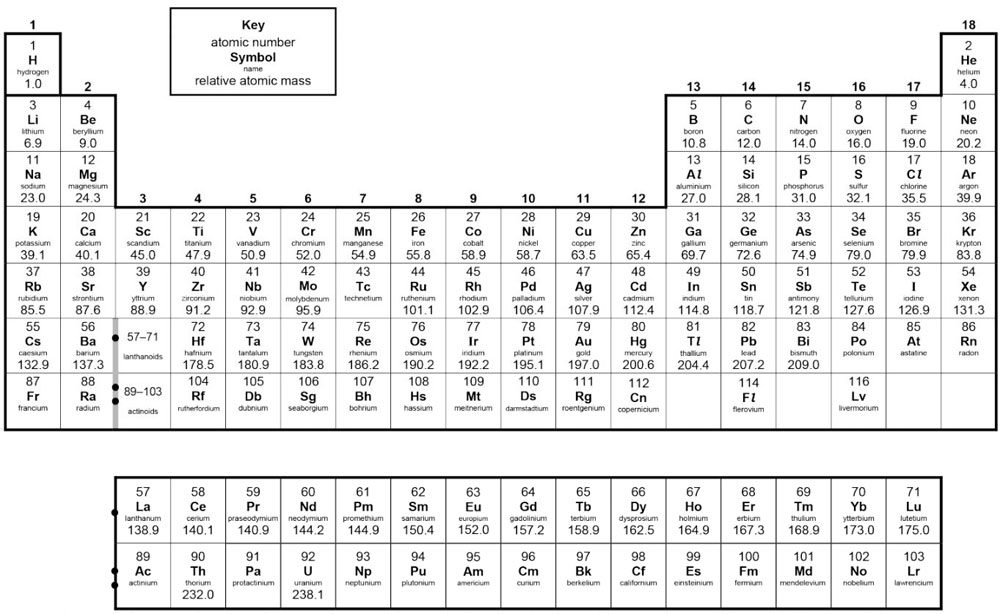
Which of these ions has the greatest polarising power?

7 / 10

A white crystalline solid gives a pale green colour in a flame. Adding silver nitrate to an acidified solution of the solid produces a white precipitate. The solid is:

8 / 10

Bubbling carbon dioxide into an aqueous solution of calcium hydroxide produces a white precipitate of:

9 / 10

The reaction of calcium with water produces:

10 / 10

What is the electron configuration of a magnesium atom?

Thank you for taking the quiz. Please fill in the fields below and you will receive your results in an email.

If you have been set this as homework, you should forward this email to your teacher as evidence you have completed the quiz.

If you don't receive your email please check your spam or junk folder.

Your score is

0%

M3S2 – Oxidation Numbers

20

Oxidation Numbers

1 / 20

What is the oxidation number of CARBON in

CO2

2 / 20

What is the oxidation number of SULFUR in

SO3

3 / 20

What is the oxidation number of CARBON in

CH4

4 / 20

What is the oxidation number of NITROGEN in

NH3

5 / 20

What is the oxidation number of CARBON in

C2H6

6 / 20

What is the oxidation number of OSMIUM in

OsO4

7 / 20

What is the oxidation number of CHLORINE in

ClO2

8 / 20

What is the oxidation number of BROMINE in

BrO-

9 / 20

What is the oxidation number of SULFUR in

SO42-

10 / 20

What is the oxidation number of NITROGEN in

NH4+

11 / 20

What is the oxidation number of MANGANESE in

MnO4-

12 / 20

What is the oxidation number of CHROMIUM in

Cr2O72-

13 / 20

What is the oxidation number of NITROGEN in

NaNH2

14 / 20

What is the oxidation number of CARBON in

CCl4

15 / 20

What is the oxidation number of SULFUR in

S2O32-

16 / 20

What is the oxidation number of CARBON in methanol

CH3OH

17 / 20

What is the oxidation number of CARBON in methanal

CH2O

18 / 20

What is the oxidation number of CARBON in methanoic acid

HCOOH

19 / 20

What is the oxidation number of OXYGEN in hydrogen peroxide

H2O2

20 / 20

What is the oxidation number of FLUORINE in

F2O

Thank you for taking the quiz. Please fill in the fields below and you will receive your results in an email.

If you have been set this as homework, you should forward this email to your teacher as evidence you have completed the quiz.

If you don't receive your email please check your spam or junk folder.

Your score is

0%

M3S1 – Periodicity


53

Periodicity

1 / 10

An example of a p-block element is:

2 / 10

An element which is a solid at room temperature consisting of molecules is:

3 / 10

An element which consists of a giant structure of atoms held together by covalent bonding is:

4 / 10

In the periodic table a periodic pattern is:

5 / 10

In which of these pairs do both entities have the same electron configuration?

(i) Li and Na

(ii) Na+ and Mg2+

(iii) F- and Cl-

(iv) Cl- and Ar

6 / 10

In the periodic table the elements are arranged in order of:

(i) atomic number

(ii) mass number

(iii) number of protons in the nucleus

(iv) number of protons and neutrons in the nucleus.

7 / 10

Which of these true statements help to explain why the values of the first ionisation enthalpies (energies) of the group 1 metals fall down the group from lithium to caesium?

(i) Down the group, the outer electron gets further from the nucleus

(ii) The charge on the nucleus increases down the group

(iii) Greater shielding means that the attraction between the nucleus and the outer electron reduces down the group

(iv) In all the atoms the outer electron is an s-electron

8 / 10

Which of these statements about atomic and ionic radii are true?

(i) Atomic radii increase down group 2

(ii) Ionic radii increase down group 7

(iii) Atomic radii decrease across period 3

(iv) In period 3 the ionic radii are smaller than the atomic radii

9 / 10

Across period 2 from lithium to neon, the first ionisation enthalpy (energy) of:

(i) oxygen is higher than that of neon

(ii) oxygen is higher than that of nitrogen

(iii) boron is higher than that of beryllium

(iv) beryllium is higher than that of lithium

10 / 10

Across period 3 from sodium to argon:

(i) the metal with the lowest melting point is sodium

(ii) the element with the highest melting point is silicon

(iii) the non-metal with the lowest melting point is argon

(iv) the melting points of all the non-metals are lower than those of the metals


Thank you for taking the quiz. Please fill in the fields below and you will receive your results in an email.

If you have been set this as homework, you should forward this email to your teacher as evidence you have completed the quiz.

If you don't receive your email please check your spam or junk folder.

Your score is

0%

M4S7 – Year 1 Organic Nomenclature

89

Year 1 Organic Nomenclature

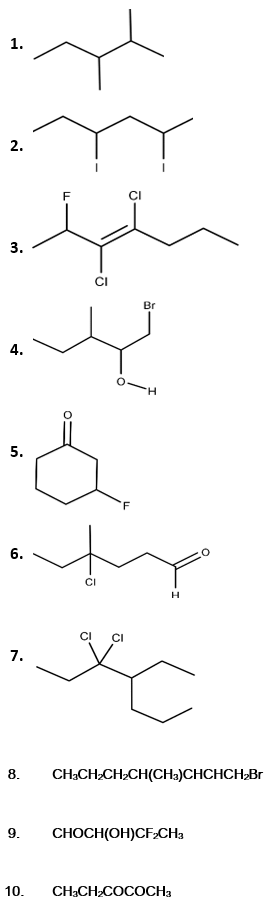
1 / 10

Choose one of the following options:

2 / 10


Choose one of the following options:

3 / 10


Choose one of the following options:

4 / 10


Choose one of the following options:

5 / 10


Choose one of the following options:

6 / 10


Choose one of the following options:

7 / 10


Choose one of the following options:

8 / 10


Choose one of the following options:

9 / 10


Choose one of the following options:

10 / 10


Choose one of the following options:

Thank you for taking the quiz. Please fill in the fields below and you will receive your results in an email.

If you have been set this as homework, you should forward this email to your teacher as evidence you have completed the quiz.

If you don't receive your email please check your spam or junk folder.

Your score is

0%

M4S6 – Year 1 Isomerism


11

Year 1 Isomerisms

1 / 12

Which of the following statements describe molecules that are structural isomers?

(i) molecules whose atoms have the same arrangement in space

(ii) molecules that have the same molecular formula

(iii) molecules in which the atoms are joined to the same neighbouring atoms

(iv) molecules which the same atoms but they are bonded in a different order

2 / 12

How many structural isomers of C6H14 are there?

3 / 12

4 / 12

How many functional group isomers of C4H8 are there?

5 / 12

How many functional group isomers of C3H6O2 are there?

It's really difficult to get all of these structures, so don't panic if you miss some. Just spend some time sketching out all the possibilities and remembering some simple rules, e.g carbon forms 4 bonds, oxygen forms 2 etc. Be creative!

6 / 12

How many structural isomers of C4H8O are there?

It's really difficult to get all of these structures, so don't panic if you miss some. Just spend some time sketching out all the possibilities and remembering some simple rules, e.g carbon forms 4 bonds, oxygen forms 2 etc. Be creative!

7 / 12

Which of the following statements describe molecules that are stereo isomers?

(i) molecules whose atoms have a different arrangement in space

(ii) molecules that have the same molecular formula

(iii) molecules in which the atoms are joined to the same neighouring atoms

(iv) molecules which the same atoms but the atoms are bonded in a different order


8 / 12

9 / 12

10 / 12

11 / 12

12 / 12

Your score is

0%

M4S5 – Instrumental Analysis IR & MS


18

Instrumental Analysis IR & MR

1 / 10

Which is the correct sequence of events that takes place in a modern mass spectrometer in the production of a mass spectrum from a sample of an element or compound?

2 / 10

The number of peaks in the mass spectrum of an element indicates the number of:

3 / 10

Species such as CH3+ and Br+ can be detected in a mass spectrum but do not occur in chemical reactions under typical laboratory conditions.

This is because in a mass spectrometer:

4 / 10

The mass spectrum of chlorine includes three peaks at mass-to-charge ratios of 70, 72 and 74.

The order of the heights of these peaks is:

5 / 10

The mass spectrum of copper has two significant peaks. The peak at 63 has a relative abundance of 69 and the peak at 65 has a relative abundance of 31.

This shows that the relative atomic mass of copper is:

6 / 10

The peak with the largest mass to charge ratio in the mass spectrum of an alkane is detected at mass-to-charge ratio = 58.

This shows that the hydrocarbon:

7 / 10

There are two main peaks in the infra-red spectrum of carbon dioxide.

This shows that carbon dioxide molecules:

8 / 10

Which of these organic compounds show a broad absorption peak caused by hydrogen bonding affecting a functional group.

(i) propanol

(ii) propanal

(iii) propanoic acid

(iv) propanone

9 / 10

Infra-red absorption ranges for some bonds are as follows:

C-H, 2850 - 3300 cm-1

C=C, 1620 - 1680 cm-1

C=O, 1680 - 1750 cm-1

C-O, 1000 - 1300 cm-1

O-H (alcohols), 3230 - 3550 cm-1

O-H (acids), 2500 - 3000 cm-1

The IR spectrum of propanal has one particularly strong absorption peak

This can be expected to be at:

10 / 10

A compound X with the molecular formula C4H10O has a broad peak in its IR spectrum at 3500cm-1.

Oxidation of X with excess potassium dichromate(VI) gives a product Y which is not an acid and does not reduce Fehling's solution.

Y has a strong peak in its IR spectrum at 1700cm-1.

Identify X and Y. (See also the data in question 9.)

Thank you for taking the quiz. Please fill in the fields below and you will receive your results in an email.

If you have been set this as homework, you should forward this email to your teacher as evidence you have completed the quiz.

If you don't receive your email please check your spam or junk folder.

Your score is

0%

M4S4 – Haloalkanes


56

Haloalkanes

1 / 10

What is the formula of 2-bromo-3-methylpentane?

2 / 10

Heating butan-1-ol with a mixture of sodium bromide and concentrated sulfuric acid produces 1-bromobutane. During the preparation the reaction mixture turns orange due to the formation of:

3 / 10

What is the main product of the reaction of 1,2-dichloroethane with a solution of ammonia in ethanol? (Under these conditions ammonia acts as a nucleophile)

4 / 10

What are the conditions for converting 1,2-dichlorethane into ethane-1,2-diol?

5 / 10

What is the name of the mechanism of the reaction between 1-bromobutane and aqueous sodium hydroxide?

6 / 10

Three halogenoalkanes differ in the rate with which they react with aqueous sodium hydroxide. The order of the rates of reaction is:

7 / 10

This procedure produces a white precipitate which dissolves easily in dilute ammonia solution: heating C4H9X for a few minutes with aqueous alkali, then acidifying the mixture with dilute nitric acid and adding silver nitrate. This shows that X is:

8 / 10

In a two step synthesis of butanoic acid what is the formula of compound X?

CH3CH2CH2Br -> X -> CH3CH2CH2CO2H

9 / 10

Products formed by heating 2-bromo-3-methylbutane with a solution of potassium hydroxide in ethanol (an elimination reaction) include:

(i) 2-methylbut-1-ene

(ii) 3-methylbut-2-ene

(iii) 2-methylbut-3-ene

(iv) 3-methylbut-1-ene

10 / 10

Which of these pairs of compounds react to form 2-bromopropane as one of the products?

(i) prop-1-ene and hydrogen bromide at room temperature

(ii) propane and bromine in ultraviolet light

(iii) propan-2-ol on heating with sodium bromide

(iv) propan-1-ol and hydrogen bromide on heating

Thank you for taking the quiz. Please fill in the fields below and you will receive your results in an email.

If you have been set this as homework, you should forward this email to your teacher as evidence you have completed the quiz.

If you don't receive your email please check your spam or junk folder.

Your score is

0%

M4S3 – Alcohols


99

Alcohols

1 / 10

Why is ethanol a liquid while propane is a gas? (Relative atomic masses: C = 12, H = 1, O = 16)

2 / 10

An alcohol consists of 64.9% carbon, 13.5% hydrogen and 21.6% oxygen.

What is the molecular formula of the compound? (Relative atomic masses: C = 12, H = 1, O = 16)

3 / 10

What type of reaction takes place on passing the vapour of ethanol over hot aluminium oxide? (Water and an alkene are produced)

4 / 10

Which reagent can be used to convert butan-1-ol to but-1-ene?

5 / 10

What is made by heating propan-1-ol under reflux with excess of a hot acidic solution of potassium dichromate(VI) and then distilling off the product?

6 / 10

What is the product when methanol and propanoic acid are mixed and warmed in the presence of a few drops of acid?

7 / 10

Which of these alcohols is a tertiary alcohol?

(i) CH3CH2CHOHCH3

(ii) CH3CH(CH3)CHOHCH3

(iii) CH3C(CH3)2CH2CHOHCH3

(iv) (CH3)3COH

8 / 10

Which of these alcohols are isomers of butan-1-ol?

(i) CH3CH2CHOHCH3

(ii) (CH3)3COH

(iii) CH3CH(CH3)CH2OH

(iv) (CH3)3CCH2OH

9 / 10

Which of these alcohols is oxidised to a ketone by a hot acidic solution of potassium dichromate(VI)?

(i) (CH3)3COH

(ii) CH3CH2CHOHCH3

(iii) CH3CH2CH2CH2OH

(iv) CH3C(CH3)2CH2CHOHCH3

10 / 10

Adding a compound X, C4H10O, drop by drop to a hot acidic solution of potassium dichromate(VI) and allowing the product to distil off as it forms, produces a compound which gives a silver mirror with Tollens solution. This shows that X could be:

(i) CH3CH2CH2CH2OH

(ii)CH3CH2CHOHCH3

(iii)CH3CH(CH3)CH2OH

(iv) CH3CH2OCH2CH3

Thank you for taking the quiz. Please fill in the fields below and you will receive your results in an email.

If you have been set this as homework, you should forward this email to your teacher as evidence you have completed the quiz.

If you don't receive your email please check your spam or junk folder.

Your score is

0%

M4S2 – Alkenes


81

Alkenes

1 / 10

Name the alkene CH3CH(CH3)CH=CHCH3.

2 / 10

A 5.6 g sample of a pure alkene with one double bond in its molecules, reacts with 16.0 g bromine. What is the formula of the alkene? (Relative atomic masses: C = 12, H = 1, Br = 80)

[1] C2H4

[2] C4H8

[3] C6H12

[4] C8H16

3 / 10

What is the H-C-H bond angle in ethene?

4 / 10

Which of these alkenes shows E/Z isomerism?

5 / 10

Which of these alkenes will produce the largest %yield of 2-bromopentane when it is reacted with hydrogen bromide?

6 / 10

The reagent which converts hex-1-ene to dibromohexane is:

7 / 10

The reaction that has the greatest atom economy is:

8 / 10

What is the product of the reaction of but-2-ene with steam in the presence of a phosphoric acid catalyst?

9 / 10

What is the mechanism for the reaction of bromine with prop-1-ene?

10 / 10

Which alkene polymerises to form this polymer?---CH(CH3)CH2CH(CH3)CH2CH(CH3)CH2---

Your score is

0%

M4S1 – Alkanes


173

Alkanes

1 / 10

Passing the vapour of a liquid mixture of alkanes over strongly heated porcelain chips produces a product which:

(i) is a gas

(ii) is highly flammable

(iii) decolourises a solution of bromine

(iv) is soluble in water.

2 / 10

The members of the homologous series of alkanes:

(i) are all straight-chain compounds

(ii) have the general formula CnH(2n + 2)

(iii) have identical chemical properties

(iv) show a regular gradation of physical properties as the number of carbon atoms increases.

3 / 10

Which of these formulae represents 2,2-dimethylpentane?

(i) CH3C(CH3)2CH2CH2CH3

(ii) CH3CH2C(CH3)2CH2CH3

(iii) CH3CH2CH2C(CH3)2CH3

(iv) CH3CH2CH2CH2CH(CH3)2

4 / 10

At a high temperature in the presence of steam, the alkane C16H24 reacts to form a mixture of ethene, propene and ethane. This is an example of:

5 / 10

How many monosubstitution products can be formed when butane reacts with chlorine?

6 / 10

One mole of an alkane needs 8 moles of oxygen for complete combustion. What is the molecular formula of the alkane?

7 / 10

Burning a hydrocarbon fuel such as methane gas in a limited supply of air is dangerous because under these conditions one of the products is:

8 / 10

An alkane in petrol is:

9 / 10

What is the name for this structure:

CH3CH(CH3)CH(CH3)CH2CH3?

10 / 10

Which of these hydrocarbons is an alkane?

Thank you for taking the quiz. Please fill in the fields below and you will receive your results in an email.

If you have been set this as homework, you should forward this email to your teacher as evidence you have completed the quiz.

If you don't receive your email please check your spam or junk folder.

Your score is

0%